How to Evaluate an AI Search Optimization Service
AI search optimization has attracted a lot of new vocabulary and very few new rules. A credible service starts from the search fundamentals the platforms document and measures what it changes.
AI search optimization, often sold as AEO or GEO, promises to get your company mentioned in AI Overviews, ChatGPT, Perplexity, and Copilot answers. Some of that work is valuable. Some of it is ordinary SEO with a new name and a higher price, and some of it makes claims no one can verify.
Here is how to tell the difference before you hire someone, based on what the search platforms themselves publish.
01 // Start from what the platforms actually say
Google's documentation on AI features is clear that the same SEO best practices apply: pages must be crawlable, indexable, and eligible to appear with a snippet, and there are no additional technical requirements or special optimizations for appearing in AI Overviews or AI Mode. Bing's Webmaster Guidelines make a similar case for clear, well-structured, crawlable content.
That gives you the first test for any service. If a provider claims a proprietary markup, a secret file, or a guaranteed placement in AI answers, ask which platform documentation supports it. A credible provider will point you to primary sources and be candid about what is uncertain.
02 // A technical baseline before recommendations
Good engagements begin by measuring the public surface as search and AI crawlers see it. That baseline should cover:
- whether important pages return the right status, are indexable, and appear in the sitemap;
- whether the main content is present in the HTML or depends on client-side rendering;
- how robots rules treat both search crawlers and AI user agents;
- page performance and Core Web Vitals on real templates; and
- structured data validity, canonical tags, and duplicate titles or descriptions.
Ask to see the baseline itself, with the evidence behind each finding, not only a score. You can get a quick first read on your own site with our free AEO report.
03 // Useful content beats volume
Google's guidance on helpful content asks whether a page was created primarily to help people, shows first-hand expertise, and leaves a reader feeling they have learned enough to achieve their goal. Answer engines reward the same qualities, because they quote passages that state something clearly and can be traced to a credible source.
A strong service will propose fewer, better pages: definitions people actually search for, comparisons that help a buyer decide, and service pages that explain what you do in concrete terms. Be cautious of plans built around publishing large volumes of thin, templated articles. They are expensive to maintain and tend to dilute the pages that matter.
Questions to ask an AI search optimization provider
- Which platform documentation supports each recommendation?
- What did the technical baseline find, and where is the evidence?
- Which pages will you improve or create, and which queries do they serve?
- How will you measure results, and which data sources will you use?
- What will you not promise, and why?
04 // Structured evidence and a clear entity
AI systems need to understand who you are before they can recommend you. That means consistent organisation details across your site and profiles, structured data that matches visible content, clear author and company information, and pages that connect to each other with descriptive internal links.
Structured data helps machines interpret a page, but it does not replace the content it describes. Markup claiming reviews, FAQs, or credentials that a visitor cannot see on the page is a liability, not an optimisation.
05 // Honest measurement
Measurement is where many AI search offers are weakest. Search Console reports on how pages perform in Google Search, and Google has added generative AI performance reports that show how a site appears in its AI features. Third-party tools that sample AI answers can show directional trends, but answers vary by user, location, and phrasing, so a single screenshot proves little.
A credible plan sets a baseline, names the queries and pages it expects to move, and reports changes in impressions, clicks, positions, and qualified enquiries over time. It also reports what did not move.
06 // What our engagements cover
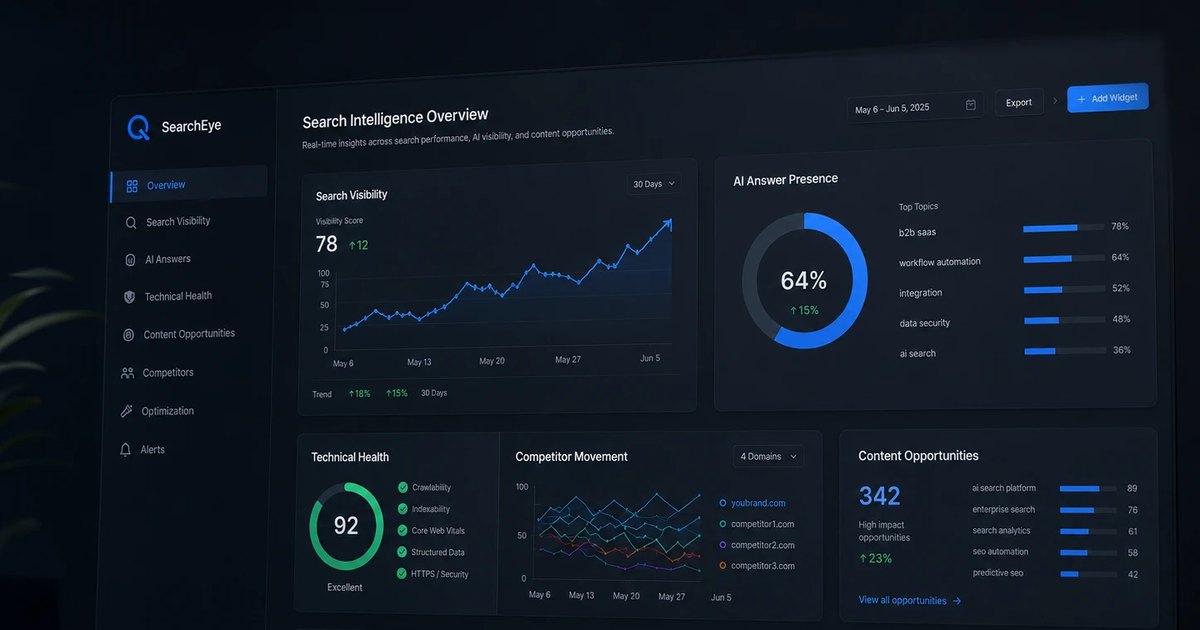
Our AI search optimization service follows this sequence: establish the public baseline, prioritise the gaps, ship connected improvements to the site, and verify the result on the live surface. The AI search optimization playbook covers the technical side in depth, and the SearchEye case study shows a product we built in the same space.
The best AI search work looks a lot like good search work, measured honestly.
Published: 2026.10.18
Keep reading